THE ROLE OF
LEARNER STRATEGIES IN
IMPROVING
VOCABULARY IN L2
E. Suresh Kumar
In the Communicative
Approach to language teaching/learning, a key goal for the learner is to
develop Communicative Competence in L2. In this connection, Language Learning
Strategies (LLS) are of immense help to the learner. The Communicative Approach
to language learning shifts the focus from the teacher to the learner.
Therefore, much of the responsibility of learning lies with the learner, and his/her
ability to make use of the opportunities to learn L2. This can be achieved to a
great extent by adapting appropriate learner strategies. The present article
makes an attempt to apply some useful learner strategies in improving ones own
vocabulary.
Various scholars defined
Learner Strategies in various ways: According to Rubin: “Learner Strategies
are, strategies which contribute to the development of the language system
which the learner constructs that affect learning directly” (22).
According to Rebecca
Oxford: “Learner Strategies are specific actions, behaviours, steps, or
techniques that students (often intentionally) use to improve their progress in
developing L2 skills. These strategies can facilitate the internalisation,
storage, retrieval, or use of the new language. Strategies are tools of
self-directed involvement necessary for developing communicative ability” (18).
It is clear from Rebecca
Oxford’s definition that ‘strategies’ can facilitate language learning and
improve communicative ability. It should be noted that Language Learning
Strategies are different from learning styles, which Reid referred more broadly
to a learner’s “natural, habitual and preferred way(s) of absorbing, processing
and retaining new information and skills”.
Though different scholars
provide different classifications of Leamer Strategies, Oxford. R provides the
most comprehensive classification of Learner Strategies:

Each sub-strategy is again
classified in more specific strategies. This article focuses only on those Learner
Strategies which are useful for the development of one’s own vocabulary.
Memory plays an important
role in language learning as it helps in storing and retrieving new
information. The human brain can store about 100 trillion bits of information
but only part of that potential is exploited in the learning process. This can
be further activated with the help of some useful memory strategies. Vocabulary
is the building block of the communication. Every year several new words are
added to the existing vocabulary list. The language learners have a serious
problem in remembering the large amount vocabulary, which is very much
necessary to achieve fluency and accuracy. This problem can be overcome by
activating memory strategies, which in turn are directly helpful in developing
effective communication.
Some specific memory strategies are: (i) grouping (ii) using imagery (iii) semantic mapping, (iv) using physical response or sensation, (v) representing sounds in memory, (vi) structured reviewing, (vii) placing new words into a context and (viii) associating/elaborating are helpful in improving the vocabulary of the learner.
To apply the specific memory strategies, learners can be given a list of words to learn and can be asked to apply different memory strategies. If they are given words like conservation, virtually, profusion, veteran, exploitation, memoirs etc., they can be asked to apply the specific strategy ‘grouping’ through which they can categorize the given words according to their parts of speech. For example the given words can be categorized accordingly:
Nouns: Conservation, Profusion, Veteran, Exploitation, Memoirs.
Adverb: Virtually
This strategy is especially helpful in improving the learner’s listening and reading skills. By applying this strategy they can understand the meaning of a word while listening to or reading a text.
The learners can apply the strategy ‘Associating/elaborating’, to expand their vocabulary further. For example the word ‘conservation’ can be associated with different words like 1. Water conservation, 2. Nature conservation, 3. Forest conservation, 4. Energy conservation.
The learners can not only try to associate the word ‘conservation’ with different words but also learn to relate words by using the strategy - ‘semantic mapping ‘.
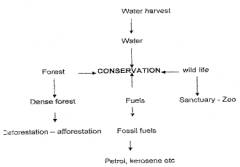
Learners can also divide words into known parts through which they remember the words and can also retrieve them whenever necessary. For example the word decode can be divided into two parts - ‘de’ and ‘code’. They can further build their vocabulary by linking the prefix ‘de’ and learn more words that start with ‘de’ , by using the strategy - ‘elaborating’ demote; deconstruct; decentralize; denaturalize; dehydrate; decompose; destabilize; devalue; deport; default;
This strategy is helpful in acquiring all the four language skills. It is helpful in understanding the meaning of the word in listening and reading while it is also helpful in using appropriate vocabulary in speaking and writing.
By applying the strategy ‘Representing sounds in the memory’ learners can remember certain words. For example the word ‘veteran’ can be remembered by associating the pronunciation of this word with a word in their L 1 (Telugu) – ‘Ventaranu’
Ventaranu - sound is similar if not the same and hence they can try to remember this word by applying the strategy – ‘associating/elaborating’ and also by the strategy ‘representing sounds in memory’.
By using the specific strategy ‘using words in rhymes’, learners can also frame their own rhymes, though they are meaningless. For example, learners can create a rhyme for the word ‘veteran’ as can be seen in the example given below:
Veteran fled to Vatican
to meet a variety of veteran
but he ran out of money there.
(Meaningless)
More words can be learnt by learning the words which end with same sound like Dine fine wine mine twine
By using the strategies ‘Associating’, ‘Using imagery’, learners can develop their vocabulary further. For example the words like – exploits and memoirs, can be remembered in the following way: The word ‘exploits’ can be learnt by associating this word with some other known word in the target language, which has some resemblance in spelling or pronunciation.
Exploit
- Ex -pilot
With the word ‘ex-pilot’ they can try to remember the word ‘exploit’. In the same way, the learners can try to remember the word ‘memoirs’ with the already known word in their target language - ‘memory’. The word ‘exploits’ can also be learnt by using the strategy ‘using imagery’. To remember this word, a learner can imagine that he has participated in some adventurous sport and is explaining his ‘exploits’ to his mends. Like this a mental picture can be framed in his mind for this word.
After practising all these strategies for improving vocabulary, learners can be asked to review all these words at different intervals - initially with a gap of one or two hours, then three times a day, then twice a week and then once in ten days and so on until the vocabulary becomes more or less automatic (strategy – structured reviewing). These memory strategies are helpful to the learners in retrieving target language information quickly, so that this information can be employed in communication involving any of the four language skills. Almost all the memory strategies are helpful in improving vocabulary, which are in turn helpful for speaking and writing respectively.
The strategies discussed above are useful in improving one’s own vocabulary. But learners cannot learn these strategies on their own. They need some external help in the way of providing strategy training by their teachers.
Teachers must have training relevant to their own instructional situations in three areas:
I) identifying students’ current leaning strategies through surveys, interviews or other means;
II) helping individual students discern which strategies are most relevant to their learning styles, tasks and goals; and
III) aiding students in developing orchestrated strategy use rather than a scattered approach.
REFERENCES
Rubin, J. “Learner Strategies: Theoretical Assumptions, research, history, and Typology.” Learner Strategies in Language Learning. Eds. Wenden, A and Rubin, J. Englewood Cliffs, NJ: prentice-Hall, 1987b. 22.
Oxford, R. A New Taxonomy of Second Language Learning Strategies. Washington DC: ERIC Clearing house on Language and Linguistics, 1985a.
....... “Second Language Learning Strategies: What the research has to say.” ERIC/ALL News Bulletin, 9. 1985b. 3-5.,
....... “Use of Language Learning Strategies: A Synthesis of Studies with Implications of Strategy Training. System, 17(2), 1989.
.........Language Learning Strategies: What Every Teacher Should Know. New York: Newbury House/Harper & Row, 1991. 16-21.
*
“Teaching language through literature is like using a sword for shaving. It is bad for the sword and harmful to the chin. “
–RABINDRANATH TAGORE