THE FEMININE PSYCHE IN THE POEMS OF KAMALA DAS AND
JAYAPRABHA: A Brief Study
D. Bala Tripura Sundari
The post
independence poetic output has a distinguished place for the women poets across
the country. Most of these women poets got
disentangled from the “Romantic escapism” and are more cool and
straightforward in their expression.
This is a
natural consequence of the cry for gender justice all the world over. The influence
of the feminist movements of the west, obviously is reflected in many writings
particularly in poetry which can be the most subjective of all literary genres.
Modern Indian women clamour for equal dignity, status and treatment on all
fronts. The spirit of liberation is voiced by many a woman individually and
collectively.
The
subjectivism of the modern poetry itself is the base of the most celebrated
American poets like Sylvia Plath Annie Sexton, Judith Sitwell. Among the
Indo-Anglian women writers, Kamala Das, Gauri Deshpande, and Mamata Kalia are
some of the earliest experimentists. Most of their works are influenced by the
feminist trends.
The
contemporary women poets attempted to project ‘woman’ as a victim of
inadequacies and suppression. At the same time they tried to project that the
failure at one point of life is not the termination of ‘individual’, but the
rejuvenation of a new ‘self’.
The poetic
output of Kamala Das has many dimensions; and it is interesting to note the
many similarities in the poetry of Jayaprabha an eminent progressive Telugu
poet. The aspects of self-assertion, condemnation of injustice are strikingly
similar in the works of both. Of course the poetic corpus of Kamala das is much
wider compared to that of Jayaprabha. Nevertheless the tone of non-conformity
to tradition is quite unique in both.
The three
major collections of Kamala Das are ‘Summer in Calcuatta’, ‘The Descendants’
and ‘the old playhouse and other poems’. Her poems are branded as obsessional
and confessional. The recurring themes of her poetry are love, sex, loneliness
with an occasional undercurrent of self-introspection fringing by philosophy.
Interestingly her introspection is not a preface to self-Denial but a firm
foundation to self-assertion.
Kamala Das
champions the cause of womanhood entangled in the marital cobwebs. She writes
about ‘love’ from a woman’s perspective. To her, the centre of love is not the
blind worship of husband but the communication of love.
As she deals
with the conflict between passivity and rebellion against the male-dominated
universe, her tussle with love, sex, lust, womanhood, motherhood has centered
itself upon her myriad relationships with her husband and other men in her
life. This forms the core of the poem ‘composition’ and other poems in ‘The
descendants’.
Her rebellion
against captivity and the attempt to achieve true freedom physically,
emotionally and spiritually is expressed in the poem ‘Introduction’. The
experience of individual existence of a woman is the central theme of
‘Introduction’. She wants to assert her freedom to choose the language most
suitable to express herself.
Which is the
true self of Woman? She postulates – ‘A name’? ‘A legion’? or Beyond?
“Dress in
sarees, be girl or be wife
They cried. Be embroiderer, cook
or a quareller with servants”
(Introduction)
She is
instructed to restrict herself to ‘Amy’, ‘Kamala’ or ‘Madhavi Kutty’.
Here, the
poet protests against the conservatism imposed on women.
Why not woman
dress the way she likes
just as men do?
Why not she
choose the language she likes?
Why not she be
herself – a poet?
Her protest
against the orthodoxy which relegates the status of woman to that of a piece of
furniture is transparent in this poem. She was disapproved by her family for
wearing men’s clothes. In turn she disapproves any ritual or custom imposed by
the caste – based conservative society.
AN
INTRODUCTION
Don’t write
in English, they said,
English is
not your mother tongue.
Why not leave
Me alone critics,
friends, visiting cousins,
Everyone of
you?…….
Then……. I
wore a shirt and my
Brother’s
trousers, cut my hair short and
ignored
My
womanliness. Dress in saris, be girl
Be wife, they
said……..
It is time to
Choose a
name, a role……….
I am sinner,
I am saint. I
am beloved and the
Betrayed. I
too call myself ‘I’.
It is
interesting to study many parallels between the poetry of Kamala Das and that
of some of the contemporary Telugu poets like Kondepudi Nirmala, Jyaprabha
etc.,
The published
works of Jayaprabha are ‘Yudhonmukhamga’; ‘Vamanudi Mudopadam’ ‘Ikkada Kurisina
Varsham Ekkadi Meghanido’; ‘Yasodhara Ee Vagapenduke’.
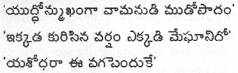
Most of her
poems are well received and well criticised also. She also has definite views
about the aspects like ‘The rights and duties of woman’, ‘The Psuedo-statement
on morals in the male-chauvenistic society’, ‘The need to bring in awareness
among women’ etc.
She is
acclaimed as a feminist writer.
The feminine
sensibility is as transparent in her poetry as the poetry of Kamala Das.
In the poem
‘Paitanu Tegaleyyali’ of Jayaprabha we find many similarities with the
“Introduction” of Kamala Das. The poet condemns the gender biased social
customs. If ‘Half Saree’ (a part of dress in Andhra Pradesh) is a symbol of
feminine abuse it should be condemned, she cries.
Jayaprabha
also feels that majority of Indian women who play the role of a faithful wife
and self-effacing mother are destined to live a passive, powerless and slavish
life throughout.
She revolts
against the heartless practices like foeticide and infanticide in the poem
‘Vamanudi Mudo Padam’.
In another
poem with the heading ‘Adathanamtho-Achanchala Viswasamtho’ there is a
close resemblance to the theme of ‘Jayasurya’ of Kamala Das, In which the
feminine sensibility is brought to the fore.
Instead of
cursing femininity both the poets at one instance feel proud of being born as
women. This elevation of thought transcends the narrow confines of sexual
bigotry. The yearning for the freedom of mind and soul embodied in the human
being is emphasized in the poem ‘The Suicide’ of Kamala Das.
It seems to
be echoed in the poem of Jayaprabha ‘Nenu Kuda Baitiki Pogaligithe’ in
which she demands a solution to the eternal problems of a desperate woman and
her outcry for emancipation and self-esteem.
Thus both the poets raise their voice of anguish; of rebellion; and also forge into mellow sentimentalism of maturity.