REMINESCENCES
TRIVENI and I
K. Sundara Rama Sarma
I give below a short summary of my relationship with the TRIVENI. Some twenty years ago, when I was in the U.S.A., I received a letter from my friend and college-mate, Mr. Bhavaraju Narasimha Rao, wherein he suggested to me to enlist about ten (permanent) life members for TRIVENI. But I choose to reply to him that my close friends in the States “do not find time” to read even interesting Magazines they get locally. So much so, I sent him my personal cheque (of U.S. Dollars) that would give about Rs. 10,000/-. In reply, he wrote to me, thanking me for the remittance and also stating that there was a surplus amount of nearly Rs. 400/-. In turn, I suggested to him that he could use that surplus amount towards any other expenses to be incurred by the TRIVENI Quarterly.
Further, I sent him copies of my collection of English poems from which he selected a couple of short poems and published them in TRIVENI. For sometime, TRIVENI was published by Mr. Dhan of Guntur.
Though my book “GENESIS AND PLAN OF THE POEM” was printed in the U.S.A., I wanted Mr. Bhavaraju to permit me to use TRIVENI PUBLISHERS INDIA, to which he readily agreed, telling me that it would be a great honour conferred on the TRIVENI Publishers. Also in the AFTERWORD, on the last page, I recorded my appreciation of the Kindness of TRIVENI PUBLISHERS for binging out this poem, for the Tripura Sundari Foundation (a Charitable Organisation, to which I am not only dedicated but with which I have identified myself, being its Founder and Managing Trustee from 1972 to 1983.
Further, Dr. Bhavaraju acted a CHAIRMAN of the Board of Trustees of the Foundation till his end. He was the first person to meet me upon my permanently returning to India in 1993.
Thanking you for giving me an opportunity to pen the above information.
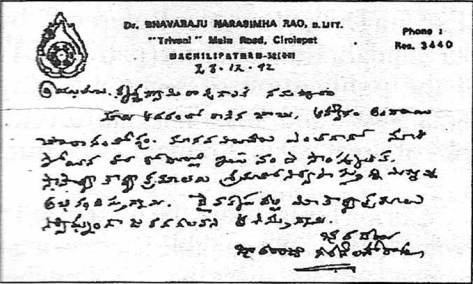
(Reproduction of postcard of Bhavaraju)
As a High School student from 1937 to 1944, I went to Coronation Reading Room at K'avali and found TRIVENI, MODERN REVIEW, BHARATHI etc., From 1955 till end I was subscriber to the BHARATHI. In 1962 I met Sri Kolavennu Ramakotiswara Rau garu. On that day a parcel arrived and he told me that it was a table he mortgaged to Sri Khasa Subba Rao garu to purchase paper for printing the TRIVENI. Sri Rau garu told me about his relationship with Khasa and sent it back. I started my subscription with its Golden Jubilee issue, reviewed in the HINDU.
Sri Bhavaraju Narasimha Rao garu told me that his share of profits in the Triveni Publishers, Machilipatnam was made over to him to enable him to constitute the Triveni Foundation. I met him in 1991 at Machilipatnam. He then told me how Sri C.V.N. Dhan of Guntur came with his wife in his car and took over publishing of Triveni. Sri Dhan brought out the Diamond Jubilee Number and then stopped. Then Sri Narasimha Rao garu gave form to the Triveni Foundation.
Sri Narasimha Rao garu used to appreciate and encourage me in conducting music festival which started in 1957 with the inspiration of Sri Ramakotiswara Rau
The member of the Advisory Council and the Advisory Board are most qualified to write articles in the Platinum Jubilee Number. Kindly write to them.
- I. Krishna Swamy Rao (Etamukkala)
TRIVENI and I
Raparla Janardhana Rao
As an old
timer of Machilipatnam, I proudly recall my acquaintance with the two stalwarts
of Triveni, its founder Sri Kolavennu Ramakoteswara Rao, and his praiseworthy
successor Sri Bhavaraju Narasimha Rao.
Sri
Kolavennu, the founder used to wear immaculate starched kurta dhoti dress with
a trim, well ironed shawl worn as upper cloth that added to his dignity,
indicating his erudition. I heard his
speech only once in Theosophical Lodge when I was fresh from college. I referred to the dictionary after going
home to find the meaning for the word “flabbergasted” which Kolavennu
used. He was fastidious in temperament
and wanted “Triveni” to be on par with any western journal, as he told me
once. Always using the feather weight
paper to withstand the ravages of time, flawless printing and publishing highly
valued articles, on literature, national culture, and integrated regional
values of our multi cultured nation Triveni earned a name. For a long time he would not brook seeing
commercial ads in his magazine. He
fondly treated and embellished ‘Triveni’ as his own daughter expending his
personal wealth on it and never proved commercial. Once I offered him a couple of apples to see him off in the first
class compartment at Machilipatnam. I
still remember his kind words to me “Oh! You spent much on this”.
I was a
fresher from the college with some little acquaintance with Kolavennu and he
saw me at the gate of Municipal Meeting held in honour of Dr. S. Radhakrishnan
the Vice-President of India. He caught
hold of my arm and took me in while I pleaded that I had no pass. It was his benevolence to the young. He forced me to sit by his side. And Radhakrishnan observing Sri
Ramakoteswara Rao in the audience, remarked “Rama Koti you are here”. It was all the warm cordial relationship,
those stalwarts in those great past days held.
Coming to Sri
Bhavaraju, our age gap reduced. As
principal, I used to get our college magazine printed in Triveni press
only. If Sri Ramakoteswara Rao was
short but ideologically devoted, Sri Bhavaraju Narasimha Rao was tall but with
the same Khadi robes worn by his mentor and practical minded. In the evenings, after my college time we
both used to meet in the streets, he with a tennis racket and white tennis
trousers going for a tennis game. I
used to smile at his trim western tennis white uniform worn by him only in the
evening times.
It was mostly
in Bhavaraju’s time monumental works of celebrated writers were published and
printing, binding were all immaculate in style. When I see the old Triveni publications, “My portrait Gallery” by
K. Eswara Dutt, “Rambler Returned” by Prof.
Kota Sundara Rama Sarma (patron of Triveni) and the publication of songs
of Tyagaraja, Syama Sastri and Dikshitar and several other books of great
value, I remain awe-struck.
During his
last days, he used to tell me that he was looking for a suitable successor and
after a change here and there, he atlast pitched upon the right person in Prof.
I.V. Chalapathi Rao.
Sorry, forgot
to tell you Sri Bhavaraju accompanied our Girls College Excursion team to
Kashmir with his wife and gave us his good company.
Dr. Bhavaraju Narasimha Rao
P. Sreerama Rao
My personal
acquaintance with Dr. Bhavaraju Narasimha Rao began in the beginning of the
year 1980. I know him through Triveni
from my college days in 1960s. He
belongs to Machilipatnam (popularly known as Bandaru in Telugu). My parents hail from Krishna District. In my childhood, I used to spend my summer
holidays in my maternal grand parent’s house in Machilipatnam, therefore I have
a liking for that place. Machilipatnam
has been very popular from the pre-independence days as a cultural and literary
center.
One day when
I was in my office going through some papers, I noticed that a person was
entering my office, through glass entrance.
He was tall and stately, dressed in pure white Khadi dhoti and round
neck lalchi and with a folded uttareeyam on his left shoulder. The figure with hundred per cent Telugu
culture coming towards me with a pleasant smile and twinkling looks. I recognized him as Bhavaraju Narasimha Rao
garu of Triveni, for whom I have lot of admiration and adoration. Immediately, I stood up and welcomed him and
requested him to be seated “Who is Sriram?”, he enquired very gently. “Myself’,
I replied and enquired with pleasant surprise “Are you not Bhavaraju Narasimha
Rao garu? He smiled and settled comfortably.
During the
conversation, I understood that he brought a message from my uncle at
Machilipatnam. Then I realized that Sri
Bhavaraju Narasimha Rao, my father and my uncle at Machilipatnam were
classmates in Machilipatnam high school.
Later he gave me a copy of group photo of their school days. I was very much impressed with the gentle
nature of Sri Bhavaraju Narasimha Rao.
Dr. Bhavaraju
was an exemplary person of simple living and high thinking. It was an experience to talk to him and to
spend time with him. He narrated many
important historical events with which he is associated that took place in
Machilipatnam. A man with abundant
knowledge.
Dr. Bhavaraju
was affectionate to me and to my family.
He used to visit my house in his morning walk whenever he was in
Hyderabad in Chikkadpally. When he
shifted to our own house to the outskirts of Hyderabad, he sent his blessing
and made it a point to visit our new house.
He was a personification of humility and nobility, courtesy and culture.
On 15th
August, 1993, he accepted our invitation, irrespective of his age and health,
to be chief guest for our annual function of “Sadhana Awards” instituted in
memory of my Parents. With great
appreciation, he distributed the awards to the students of our colony, who
secured highest marks in seventh, tenth and intermediate examinations held in
the preceding academic year.
Dr. Bhavaraju
was a man of many facets. He was a very
good writer and a good speaker on Indian culture and literature. He has written many articles in various
popular journals and gave talks on the Radio.
He was author of the biography of Dr. Pattabhi Seeta Ramayya, the great
freedom fighter of Machilipatnam and President of All India Congress Committee
during Gandhian days. Dr. Pattabhi
Seetha Ramayya was the founder of Andhra Bank in Machilipatnam and it is now
one of the most popular nationalised Banks in India. He was a good tennis player and a man of high principles.
Dr. Bhavaraju
was the founder Secretary of “Saraswatha Mandali” for twenty four years from
1930 to 1954. At the age of 16 he
started this literary association.This Association conferred the title of
“Kavi Samrat”on the great Telugu
Scholar and poet Sri Viswanatha
Sathyanarayana in 1934 during his tenure as Secretary. He was also the founder Secretary of
araswatha Kala Samithi, a cultural organisation during 1957-1967.
Dr. Bhavaraju
started “Triveni Press” and “Triveni Publishers” in 1946. It was inaugurated by none other than
Kolavennu Rama Koteswara Rao, the founder of Triveni. The well known Telugu poet Sri Katuru Venkateswara Rao presided
over the function. Well known
personalities of Machilipatnam, including Dr. Pattabhi Seetha Ramayya were
present on that occasion.
In 1949, he
took over the responsibility of running the journal “Triveni”. He became the Managing Editor of Triveni in
1960. He became the Editor in 1970
after the passing away of Sri Kolavennu Ramakoteswara Rao. He ran the journal Triveni with high values
with lot of strain and stress until his last breath on 27.11.1993.
Dr. Bhavaraju
had a high regard for our scriptures and he had a deep desire to popularise
them to the common man. He published in
1955 “Valmiki Ramayanam” in Telugu translated by Sri Srinivasa Siromani. He published many other classics through
Triveni Publishers. His contributions
to Telugu and English literature are commendable.
Dr. Bhavaraju
established a Trust with other elders of Machilipatnam in the name and style of
“KAVIPRABHA”, the full form is Kavi Samrat Viswanatha Pratibha Bharati, in 1983
to preserve and propagate the writings of the great Telugu poet and
Scholar. The trust conducted many
memorial lectures by eminent writes of Telugu and published them.
Dr. Bhavaraju
was honoured by many associations.
Nagarjuna University conferred on him the Degree of Doctor of
letters. He was a member of Bharateeya
Jnanapeetha Awards Selection Committee (Telugu Division). He was also a member of Best Book Prize
Selection Committee of A.P. Sahitya Akademi.
He was President of Machilipatnam Press Club during 1981-82.
Bhavan’s
Journal in its obituary on Bhavaraju Narasimha Rao paid high compliments. Also stated that: “His article entitled
“Noble Thoughts for a Happy life” appeared in the “Bhavan’s Journal” of April
1-15, 1986. It is worth reading. The article reflected the man and his mind”.
Dr. Bhavaraju was a friend, philosopher and
guide to many individuals, institutions and organisations. I am one of the beneficiaries.
THE TRIVENI DUO
E.
Nageswara Rao
There are
only two persons in the chequered history of Triveni in the last
seventy-five years who have nourished it in times of grave crises. They are the founder-editor, Sri Kolavennu Ramakotiswara Rao and Dr.
B. Narasimha Rao. The idealism of the former and the dedication of the latter
saved it quite a few times. The
editorial and managerial set-up and even the place of publication have
changed. The mutual trust and steadfast
loyalty of these two gentlemen rescued the journal while comparable journals
suffered either infant mortality or adolescent asphyxia.
I never met
Sri Ramakotiswara Rao, but I had corresponded with him a good deal. When I was a student in the English honours
class at the Andhra University, I sent him an article on the stream of
consciousness technique. He promptly
accepted it and wrote an affectionate and encouraging letter in his own
characteristic hand. He also sent me an
honorarium and twenty-five off prints.
My joy new no bounds. It was my
first publication outside the collage magazines; it bought me my first earned
income; it gave me a place in a respectable journal in the country. Such journals were very few in those
days. A couple of years later, Dr B.
Narasimha Rao, then the journal’s publisher, met me in Narsapur and told me
that on reading my article, the editor predicted that I would make a mark as a
teacher. By then I had joined the
teaching profession.
Sri
Ramakotiswara Rao impressed on me, the need to write on our own literatures
rather than on English literature so that people in other parts of our country
know our literatures. Long before
translation became rage, he encouraged the translation from Indian literatures
into English, thus providing a wider audience to Indian literature. Almost every number of Triveni
carried a few translations. When I sent him an article on “The pastoral
Tradition,” he urged me to include pastoral poetry in our literature. I readily accepted his friendly advice and
added a section on the pastoral elements in our own literatures.
The
impression I got of Sri Ramakotiswara Rao through the letters we exchanged was
that he was gentle, genial and generous person.
Dr. B.
Narasimha Rao who took up the publication, and later the editorship of Triveni
was his brother-in-law who held the editor in great esteem. I had met at various places and many
times. We exchanged notes on editing
and publishing journals such as Triveni. On my return from the Canada, I suggested that Triveni
could be raised to an international standard if there is a more rigorous
screening and editing of articles. I
urged him to adopt the MLA Stylesheet for documentation and gave him a
copy. When the journal was revived and
shifted to Hyderabad, Dr. Narasimha Rao sought my support and cooperation. I contributed articles and reviews whenever
he asked me. I introduced quite a few
contributors and reviewers to the journal.
I had also enrolled almost all the institutions with which I was
associated both in India and abroad as subscribers.
Sri
Ramakotiswara Rao and Dr. B. Narasimha Rao are a rare combination reminding one
of the legendary partnership of Krishna and Arjuna. They shared a taste for literature and the fine arts, a civilized
outlook, a deep respect for Indian culture, and a life-long commitment to Triveni. The journal’s continued several vicissitudes
is a tribute to the indomitable spirits of this Triveni duo.
Dr. Bhavaraju Narasimha Rao – a tribute
Andavilli Satyanarayana
When I was in Hyderabad on some personal work, I rang
up Dr. Narasimha Rao garu on 25th November, 1993 and sought an
appointment with him. He asked me to
come to his house next day at 10 a.m.
When I went there, he was waiting for me and received me very warmly. We recalled our earlier meeting in
Vijayawada when he was felicitated by a Committee of hosts on his being
conferred ‘Kala Prapoorna’ by the Andhra University. I felt greatly honored when he said that he was regularly reading
my weekly column in ‘The Indian Express’.
I was particularly pleased when he referred to some of the pieces in the
Column and complimented me. We talked
about many things. Two, three times I
stood up to leave saying that I did not like to encroach upon his busy
schedule. But, he made me feel quite at
ease and every minute of my three-hour stay with him I was conscious of being
in the presence of a remarkable person of endearing and enduring qualities.
When I told him that I lost the copy of K. Iswara Dutt’s “Street of Ink” which was given to me by late Khasa Subba Rao just a few days after Iswara Dutt himself presented it to him with his signature, he took out the book from his shelf and showed it to me. I told him that I had brought a few copies from Triveni Publishers for presentation to my friends but I did not have one for myself. He promised to get it from Iswara Dutt’s son in Delhi and wanted me to contact him after a fortnight. By then it was time for lunch and he asked me to join him. I told him that my host would be waiting for me and sat with him taking a cup of coffee while he had his meal. It was them 1 P.M. and he saw me off coming upto the gate.
On 28th morning, when I opened the paper, I saw the shocking news that he passed away on 27th after a stroke. I couldn’t believe it as I found him hale and healthy and full of energy to put ‘Triveni’ publication on sound lines so that it could go on whether he was there or not keeping up its highest standards of excellence established by its founder Kolavennu Ramakoteswara Rao and maintained by him till then facing all odds. Immediately I rushed to his house and saw him, a picture of composure, serene and dignified in death as in life. There I met several of his friends who came to pay their last respects. I told my good friends, I. V. Chalapathi Rao and B. Parvatel Rao then about my spending three hours with him just 24 hours before he was snatched away from our midst. It was a privilege which I cherish and if my desire to share this with friends through the pages of ‘Triveni’ sounds like trying to shine in the reflected glory of that great person, I seek their indulgence as I hope it is a pardonable vanity!
“His life was gentle, and the elements
So mixed in him that nature might stand up
And say to
all the world, “This was a man!”