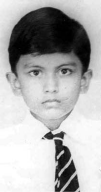
Sai Shiva Narayana
(22 June 1971 - 4 April 1988)
IN MEMORY OF SAI SHIVA NARAYANA
This April-June issue of Triveni is sponsored by Lt. Col. K. R. Murty, a philanthropist, in memory of his son SAI SHIVA NARAYANA who left this planet at the tender age of 16. (Born on 22nd June’71 and left this world on 4 April ’88)
That the boy was a Yogi was clear to his father from the miraculous experience of a dream in which Shiridi Sai Baba sent the child through the resplendent rays falling on the father.
From now on wonderful things happened to show that the boy was a child prodigy manifesting rare powers. Without being put to school, he learnt reading to the extent of reproducing from memory the entire list of animals in the Index of an Animal Book! He could understand and repeat from memory the slokas of ‘Bala Ramayana.’ At the age of seven he could read an English play and tell the story back! There were many other things which showed his extraordinary abilities and prodigious memory.
As he began to grow up he became painfully aware and was hurt by the realities of this hypo-critical world. At the age of eight he was shocked when the head mistress of his school sold the note books at double the price without compunction. He remarked “It is unbelievable that our headmistress sells notebooks at double the price.” This must have shattered his faith in the elders and role models. He wrote in a letter to his friend: “A ‘friend’ pinched all my coin collection.” A boy walked away with his bound comic books! At 14, when some one asked him “What is your caste?” he got perturbed. This made him refuse ‘Upanayanam’ later!
When real life left him cold, he sought solace in English poetry, especially the poems of Shelley and T. S. Eliot and in J. K.’s philosophy. One should read a brief article he contributed to the ‘Indian Express’ in which he expressed his views on ‘GOOD EDUCATION’. They are still valid. Nothing that has happened afterwards made them irrelevant or dated! He had a brilliant scholastic career. At the age of fourteen and half he won the National Talent Scholarship. He joined the Victoria Jubilee Technical Institute (VJTI) in June’87 in Electronics and Communications. He was one of the brightest of his batch. He wrote poetry.
Clouds began to gather in the sky. Soon Siva Narayana grew meditative, tired of life and world weary. He was disgusted with what he saw around him – drastic decline in values, corruption in high places, hypocrisy of politicians and avarice of the elders. Poverty of the slum dwellers and hard heartedness of the exploiting classes were too much for the sensitive boy. It led to rejection of life, renunciation and a quest for liberation. His immature mind could not find either an answer to the perplexing questions or an explanation for what happens between the miracle of life and the mystery of death.
Before he breathed his last his last wish was that his writings should see the light of day. I have read his poems and articles. They are marked by maturity, mellowed judgement and spirituality which are far beyond his years. He walked into the bosom of God shuffling off his mortal coil.
- EDITOR
WORDS
We talk
We speak continuously
But we do not act
It is a fact
That we hide behind words.
We give
Speeches and lectures
Whether we mean it or not
And on the spot
We conjure false words
To hide our shame.
Words
Are our shield
From any complaint
Is it not quaint
That even today
Man fights his wars with words.
Not small frys
Not ordinary people
But Heads of state
Don’t hesitate
To talk on and on
Sans meaning sans purpose
Words mean nothing
Do n ot convey
A message; NAY
They are shallow
Thay are empty
But that is all
The intellectuals
The thinkers
The leaders
Have to offer to society.
THE
RAT RACE
Up and down they move
Like busy rats all
Hearing not a whimper
Nature’s frequent call.
“Please, men and women
Stop this moving fast
return to living
As you did in the past.”
But they continue
and pay just no heed
Time is catching up, they say
We can’t concede a lead.
We must forever hurry
We must now progress
This is a time for work
There’s no time for rest.
Like busy rats collecting
Little crumbs of food
They work, pamper, whimper, slave
Forget all that’s good.
And little do they bother
Will do the same in Future
they are like proud rodents,
We won’t return to nature:
And realize not their
loss.